
 Tiếng Việt

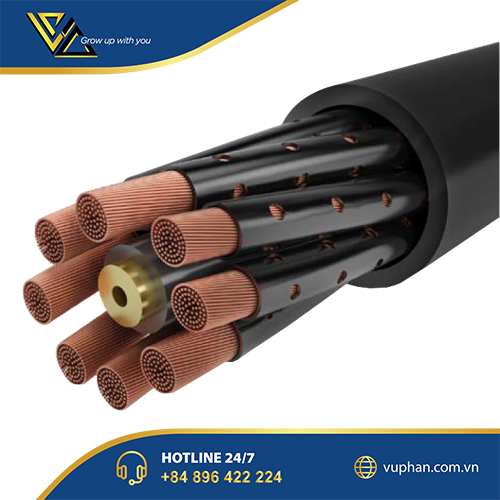
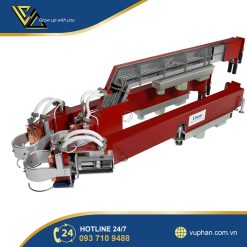
WATER-COOLED POWER CABLE FOR EAF/LF FURNACES
1. What is a Water-Cooled Power Cable?
Water-Cooled Power Cable, also known as an EAF electrode cable, is a specialized electrical conductor used in high-power systems, especially Electric Arc Furnaces (EAF) and Ladle Furnaces (LF).
Unlike conventional cables, water-cooled power cables are designed with an internal water circulation system to reduce temperature during high-current transmission, ensuring stable operational performance and extending equipment lifespan.
BRAR water-cooled power cables are recognized for high current carrying capacity, excellent mechanical durability, and stable operation in harsh industrial environments. This is an optimal solution for EAF electrode cable systems in modern steelmaking and metallurgical industries.
With specialized design, efficient cooling capability, and high operational stability, EAF electrode cables help reduce heat losses, minimize failures, and improve overall electric arc furnace system efficiency.
1.1 Structure of BRAR Water-Cooled Power Cable
BRAR water-cooled power cables are designed with a multi-layer structure to ensure high-power electrical transmission, efficient cooling, and superior durability. The main components include:
Conductive Core (Copper ropes): High-quality electrolytic copper strands providing stable conductivity, flexibility, and reduced mechanical stress.
Outer Rubber Hose: Heat-resistant and pressure-resistant hose protecting the cable from mechanical impacts and environmental conditions.
Copper Terminal: Precision-machined terminals using compression technology for excellent electrical contact and minimized power loss.
Bands / Clamps: Secure the cable structure while ensuring sealing performance and mechanical durability during operation.
Central Tube: Provides continuous cooling water circulation to reduce temperature and maintain stable performance.
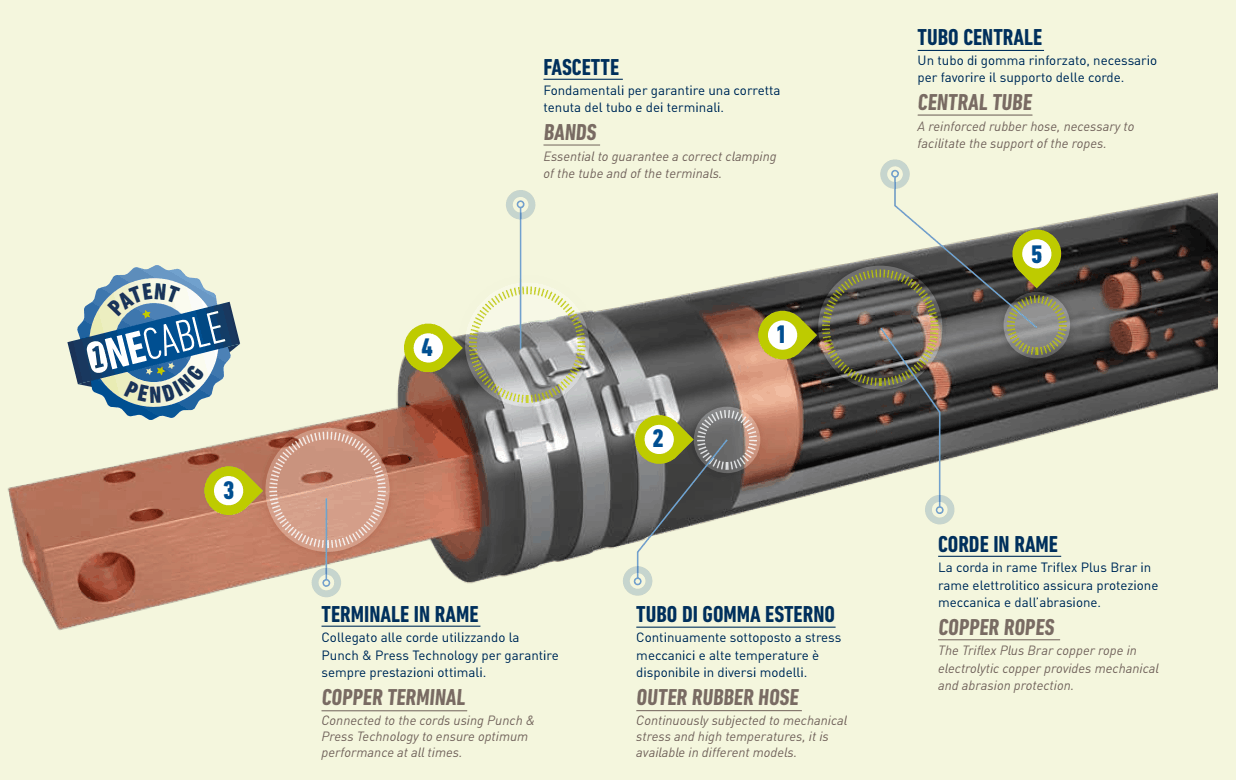
1.2 EXPLORE THE DETAILED STRUCTURE OF BRAR POWER CABLES
Explore each structural component of BRAR water-cooled power cables to better understand the operating principle and optimize system selection.
1.3 Operating Principle of BRAR Water-Cooled Power Cable
BRAR water-cooled power cables operate based on the combination of high-power electrical transmission and forced water cooling circulation, helping maintain stable operating temperatures during operation.
1.3.1. Electrical Transmission Through Multi-Strand Copper Core
Electrical current is transmitted through high-conductivity electrolytic copper ropes arranged in strand bundles to improve flexibility and evenly distribute electrical and mechanical stress during operation.
1.3.2. Heat Generation During Operation
When high current flows through the cable, heat is generated due to:
- Joule losses (I²R)
- Electromagnetic forces and mechanical vibration
- High-temperature furnace environment
This increases electrical resistance and reduces efficiency if cooling is insufficient.
1.3.3. Water Cooling Circulation
Cooling water flows through the central tube inside the cable continuously along the cable length to:
- Absorb heat from the copper core
- Reduce operating temperature
- Maintain stable electrical resistance
Typical operating conditions:
- Water inlet ≤ 30°C
- Temperature difference ΔT < 5°C
- Operating pressure: 3–6 bar
1.3.4. Optimized Electrical Contact at Cable Terminal
Electrical current is transferred to the system through copper terminals using Punch & Press technology:
- Direct mechanical compression of copper strands into the terminal
- Reduced contact resistance
- Improved transmission efficiency and connection durability
1.3.5. Protection and Operational Stability
The heat-resistant rubber hose and clamping system:
- Protect the cable from heat, impact, and chemicals
- Maintain cooling water system sealing
- Reduce vibration and cable twisting
2. APPLICATIONS AND ADVANTAGES OF BRAR WATER-COOLED POWER CABLES
BRAR water-cooled power cables are specially designed for high-power systems requiring large current transmission and continuous operation under harsh conditions. The products are widely used in:
Electric Arc Furnaces (EAF)
Ladle Furnaces (LF)
Submerged Arc Furnaces (SAF)
High-power induction furnaces
Secondary power transmission systems in steel plants
In these applications, the cable not only functions as a power conductor but must also ensure thermal stability, mechanical durability, and long-term operational reliability. This is the key difference between BRAR and conventional solutions.
BRAR is one of the pioneers in water-cooled cable technology with numerous engineering innovations that optimize operational efficiency:
Exclusive Punch & Press technology improves electrical contact, reduces resistance, and minimizes hotspot generation
Triflex Plus design enhances mechanical durability, reduces wear, and extends cable lifespan
Reduces vibration and cable twisting, stabilizing the system during continuous operation
Uniform stress distribution minimizes damage at high-load points
Superior efficiency and service life compared to conventional cables
Thanks to these advantages, BRAR power cables not only ensure stable operation but also reduce maintenance costs and downtime.
In practice, most systems using BRAR cables also implement upgraded solutions such as rotating terminals and monitoring systems to further optimize performance and operational safety.
3. IMPORTANT CONSIDERATIONS WHEN SELECTING EAF/LF ELECTRODE CABLES
Selecting the correct EAF/LF electrode cable is a critical factor affecting system efficiency, operational safety, and furnace lifespan. A properly selected EAF/LF electrode cable system helps reduce energy losses, stabilize operation, and minimize failures.
3.1 Current Carrying Capacity and Furnace Power
When selecting EAF/LF electrode cables, the operating current and furnace power must be accurately determined. The cable must withstand continuous heavy loads without overheating to ensure stable operation.
3.2 Conductive Core Structure
EAF/LF electrode cables should use high-quality electrolytic copper cores (Cu-ETP / Cu-HCP) with multi-strand structures to:
- Improve electrical conductivity
- Reduce mechanical stress
- Minimize internal cable wear
This is an important factor for maintaining long-term performance.
3.3 Water Cooling System
For EAF/LF electrode cables, the cooling system plays a key role:
- Ensure stable water flow and pressure
- Directly cool the conductive core
- Control operating temperature
An efficient cooling system significantly reduces cable temperature and extends service life.
3.4 Rubber Hose and Protective Layer
EAF/LF electrode cables should be protected by rubber hoses with:
- High heat resistance
- Abrasion and impact resistance
- Resistance to furnace environments
Selecting the correct material helps ensure long-term durability under harsh conditions.
3.5 Electrical Terminal
Cable terminals must provide:
- Optimal electrical contact
- Low resistance
- Strong mechanical structure
Mechanical compression technology is recommended to improve operational stability.
3.6 Mechanical Durability and Vibration Resistance
During operation, EAF/LF electrode cables are exposed to vibration and strong electromagnetic forces. Therefore, the cable should be designed to:
- Remain flexible
- Distribute stress evenly
- Limit deformation
This helps reduce damage and extend service life.
3.7 Anti-Twisting Capability (Rotating Terminal)
For modern systems, EAF/LF electrode cables should integrate rotating terminals to:
- Reduce cable twisting
- Reduce mechanical stress
- Improve operational stability
3.8 System Compatibility
EAF/LF electrode cables must be compatible with:
- Furnace design
- Electrodes
- Lifting systems
System synchronization improves operational efficiency.
3.9 Periodic Inspection and Maintenance
To ensure optimal performance, EAF/LF electrode cables should be inspected regularly:
- Cooling system
- Electrical contact points
- Mechanical structure
Proper maintenance helps maintain stable operation and avoid failures.
4. WHY CHOOSE BRAR EAF/LF ELECTRODE CABLES FROM VŨ PHAN
Vũ Phan is the official BRAR distributor in Vietnam, specializing in supplying EAF/LF electrode cables and high-power electrical transmission solutions for the metallurgical industry.
As a commercial representative of leading global brands, Vũ Phan is committed to supplying genuine BRAR water-cooled power cables with full CO/CQ documentation and compliance with international technical standards.
With practical experience in numerous steel plants, Vũ Phan not only supplies EAF/LF electrode cables but also provides comprehensive engineering solutions to optimize operational performance and extend system lifespan.
Commitments from Vũ Phan:
- 100% Genuine Products:
Supply genuine BRAR EAF/LF electrode cables with full CO/CQ documentation, ensuring quality and traceability.
- Professional Technical Consultation:
Support proper selection of water-cooled power cable configurations according to furnace power, operating current, and working conditions.
- Optimized Solutions for Each Application:
Analyze actual system conditions to recommend suitable cable types that reduce energy losses and improve efficiency.
- Installation and Operation Support:
Provide detailed technical guidance to ensure stable and safe operation of the electrode cable system from the beginning.
- After-sales Service and Maintenance:
Long-term partnership with periodic inspection support and fast troubleshooting response.
- Competitive Pricing – Optimized Investment Cost:
Deliver effective EAF/LF electrode cable solutions with reasonable costs for heavy industrial enterprises.
Choosing BRAR EAF/LF electrode cables from Vũ Phan is a reliable solution for achieving stable – safe – high-efficiency furnace operation while optimizing long-term operating costs.
Reviews
There are no reviews yet.